Advanced NEGATIVE RAKE SCRAPERS with Replaceable Blades (NRS) PATENT PENDING
3rd Generation Unsurpassed Performance NRS
Stuart Batty pioneered and developed the Negative Rake Scraping technique in the 1990s to complement his Batty Push-Cut woodturning style and his renowned 40/40 and bottom bowl gouge grinds.
Though Stuart named it Negative Rake Scraping, it is a form of non-flexible abrasion when used correctly. This makes it the most effective technique for refining the final shape, removing tool marks, or eliminating torn grain.
Negative Raking Scraping is a very user-friendly technique that requires only the blade edge to be at center height with the tool/handle parallel to the floor. It does not require pointing downhill like a conventional scraper.
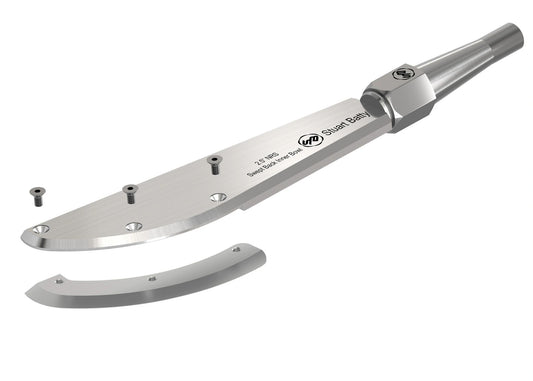
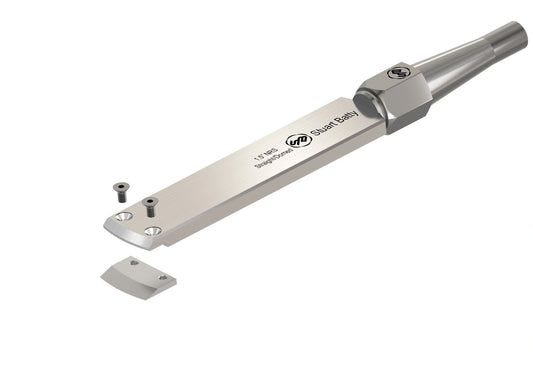
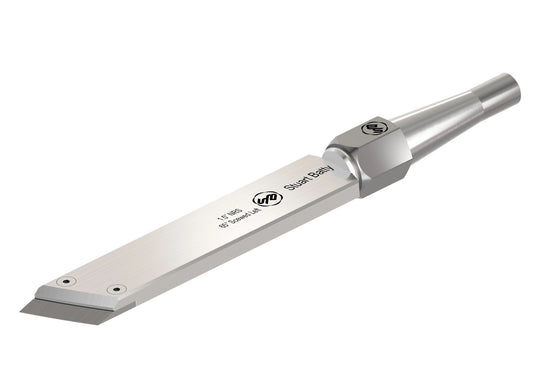
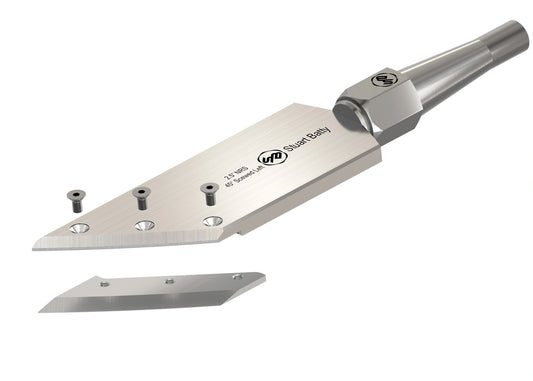
Our new Negative Rake Scrapers are a 3rd Generation (Patent Pending) advanced design that provides enhanced stability and a cost-effective replaceable blade system.
Our NRS are precision machined 3/8” thick heat-treated hardened stainless steel fitted with long edge/burr retention 10V steel blades and our unique taper lock bolster for secure, fast locking/unlocking in our advanced handle system. Removing the tool from the handle makes resharpening easier.
For the first time in woodturning, we will offer replaceable 15V blades in August for this series.
Negative Rake Scraping relies entirely on the burr to shape the wood surface through abrasion. This is why we use 10V and now 15V for our NRS blades, as the burr wears down faster than a cutting edge.
10V holds an edge/burr up to 350% longer than M42. 15V holds an edge/burr up to 50% longer than CPM 10V.
Our new NRS blades are supplied with a 20° negative rake top angle, requiring only the lower bevel to be ground to create the burr using either a wheel or belt. The blade must be replaced once the top 20° bevel angle is ground away.
Using our Angle Gauges, you can choose what grind angle you wish to create the burr. 20° creates a bigger burr than higher bevel angles. However, you can set the grinding platform at any of the following using our Angle Gauges: 22.5°, 25°, 30°, 35° & 40° for an effective abrasion burr.
Each replaceable 10V & 15V blade can be resharpened numerous times, depending on the abrasive grit used and how much pressure is applied while forming the essential burr on a wheel or belt. More pressure against the abrasive will create a slightly bigger burr but will take more metal off the blade.
80 Grit: Creates a very large burr & approximately 100 regrinds (Longest Burr Life)
120 Grit: Creates a large burr & approximately 150 regrinds
180 Grit: Creates a medium burr & approximately 200 regrinds
220 Grit: Creates a medium burr & approximately 240 regrinds
320 Grit: Creates a fine burr & approximately 350 regrinds
600 Grit: Creates a very fine burr & approximately 600 regrinds (Shortest Burr Life)
On our “Videos” page, you can view several of Stuart Batty’s videos showing his Negative Rake Scraping technique and how to create the best burr for extended working life. Also available is the first-ever article on this technique, written by Stuart in 2006 for the AAW.
To make Negative Rake Scraping effective, a blade with a top and bottom bevel, like a skew, is required. Conventional scrapers have only one bevel; pointing it downward does not make it a Negative Rake Scraper. It will remain aggressive, especially on end grain and denser woods. Secondly, the NRS blade must have a burr created from a grinding wheel/belt and not a burr created with a burnisher/ticketer, as this is a curled edge. Once the NRS burr is worn down, the tool will become ineffective as an NRS and must be resharpened to recreate a new burr on the blade edge.
Note: Negative Rake Scraping is very effective on medium to very dense woods and even those impregnated with polymers. Very soft or spalted woods tend not to Negative Rake Scrape well as the wood fiber wraps over the metal burr and prevents it from working as effectively as it does for harder woods.
Why Negative Rake Scaping is So Effective
Unlike conventional and carbide scrapers, which must be narrow to reduce their aggressive nature. Our NRS has blades up to 6” wide and is never aggressive, no matter how much of the edge/burr is in contact with the wood at once.
Supplied with the two longest-lasting edge/burr tool steels (10V & 15V), they are exceptional at removing tool marks, uneven surfaces, and torn grain.
Note: Conventional & carbide scrapers want to self-feed, especially on end grain and dense woods. Carbide scrapers cannot be ground to create a burr to use as a negative rake scraper.
New Negative Rake Scrapers (NRS): Advanced Design & Replaceable Blades
Stuart Batty pioneered this technique & developed our advanced NRS tools to outperform all copies.
- Precision-machined 3/8” thick heat-treated & hardened stainless steel NRS body
- 10V Replaceable blades for exceptional edge/burr life ever
- Extremely long edge/burr life New 15V blades
- 20 Unique shapes & sizes available
- Extremely easy and stable to use
- Shipped sharpened & ready to use
- Supplied with our taper lock bolster for fast handle removal for easier sharpening